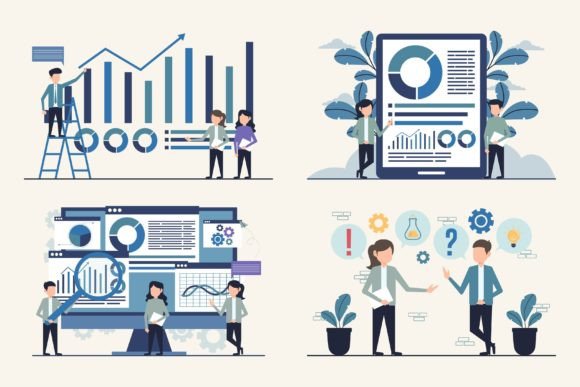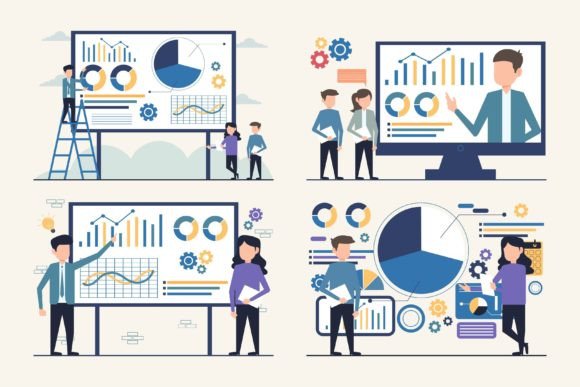
Mastering Visual Communication: A Deep Dive into Business Strategy and Data Analysis Vector Assets
In the modern digital landscape, the ability to convey complex information quickly and effectively is a critical skill for professionals across every industry. Whether you are a business owner presenting a quarterly report, an educator explaining statistical trends, or a designer creating a landing page, the visual representation of your data determines how well your message is received. This is where a comprehensive Set of Business Strategy and Data Analys becomes an indispensable tool. Unlike static images that degrade when resized, vector-based graphics offer unparalleled flexibility, ensuring that your strategic insights remain crisp and professional regardless of the medium.
The Evolution of Strategic Visualization
Historically, business strategy and data analysis were confined to spreadsheets and dense text documents. While these formats are excellent for raw data storage, they often fail to engage stakeholders or communicate the "big picture" efficiently. The shift towards visual storytelling has transformed how organizations approach decision-making. Today, infographics, dynamic dashboards, and interactive web elements are standard expectations in corporate communication.
The transition from raster images (pixel-based) to vector graphics marks a significant leap in design capability. Raster images, such as JPEGs or PNGs, lose quality when scaled up, resulting in pixelation that undermines professionalism. In contrast, a high-quality Set of Business Strategy and Data Analys built on vector technology ensures that every line, curve, and icon remains sharp at any size. This scalability is not merely a technical convenience; it is a strategic asset that allows designers and analysts to adapt their visuals for everything from a small mobile notification to a massive stadium-sized banner without compromising integrity.
Understanding the Power of Vector Technology
At the core of this design revolution is the vector format, specifically the EPS (Encapsulated PostScript) standard. Vectors use mathematical equations to define shapes rather than a grid of colored pixels. This fundamental difference means that you can transform, scale up or down, add or remove elements, and recolor assets without losing any quality. For professionals working on long-term projects, this longevity is crucial. A graphic created today for a website header can be repurposed tomorrow for a printed annual report or a social media campaign, maintaining its pristine appearance throughout its lifecycle.
The versatility of vector files extends beyond simple resizing. Because the elements are distinct and editable, users have the freedom to customize the artwork to match specific brand guidelines. You can easily adjust the color palette to align with corporate identity, modify the typography within the illustration, or isolate specific components to create new compositions. This level of control empowers teams to maintain consistency across all communication channels while retaining the agility to respond to changing market conditions.
Core Applications in Modern Workflows
The utility of a robust collection of business and data illustrations spans a wide array of applications. Understanding where and how to deploy these assets can significantly enhance the impact of your work. From the initial concept phase to final presentation, these tools integrate seamlessly into various workflows.
- Web Graphics and Mobile Interfaces: In the realm of web design, load speed and clarity are paramount. Vector assets are lightweight and render sharply on high-resolution retina displays. They are ideal for hero images, background patterns, and interactive icons on mobile web apps. When a user zooms in on a data chart on their smartphone, a vector graphic ensures the details remain legible, whereas a raster image would blur.
- Landing Pages and Conversion Optimization: A compelling landing page relies on immediate visual engagement. Using a Set of Business Strategy and Data Analys allows creators to craft unique hero sections that explain value propositions instantly. Infographic-style elements can break down complex service offerings into digestible visual steps, guiding the user toward conversion.
- Banners and Digital Advertising: Advertisements must capture attention in seconds. Vector banners allow for bold, clean lines and vibrant colors that stand out in crowded feeds. The ability to scale these assets means one master file can generate ad variations for different platforms—from Facebook stories to Google Display Network banners—without needing to recreate the artwork from scratch.
- Infographics and Educational Materials: Educators and researchers often deal with dense datasets. Transforming this data into engaging infographics makes the information accessible to a broader audience. Vector illustrations allow for the precise placement of charts, graphs, and explanatory icons, creating a narrative flow that guides the reader through the data story.
Enhancing Presentations and Reports
Corporate presentations are often the make-or-break moment for strategic initiatives. Generic clip art can undermine the credibility of a pitch. Customizable vector assets provide a polished, bespoke look that elevates the perceived value of the content. When a CEO presents a growth strategy using custom-designed charts and diagrams that align perfectly with the company's branding, the message carries more weight. The ability to edit individual elements means that if a data point changes during the meeting, the presenter can update the visual immediately without breaking the flow of the presentation.
Strategic Advantages for Diverse Users
The benefits of utilizing a comprehensive library of vector business graphics extend to a diverse range of users. Each group leverages these tools differently to solve unique challenges.
For Business Owners and Executives: Time is a scarce resource. Having access to a pre-made set of high-quality assets reduces the dependency on external agencies for routine visual needs. It streamlines the internal creation process, allowing leadership teams to focus on strategy rather than design logistics. The ability to visualize data clearly helps in making faster, more informed decisions and communicating those decisions effectively to investors and employees.
For Designers and Creators: Professional designers know that starting from a blank canvas can be time-consuming. A library containing 100 vector source files provides a solid foundation. These files serve as building blocks that can be deconstructed and reassembled into entirely new designs. The inclusion of high-resolution JPG previews alongside the editable EPS files allows for quick mockups and client approvals before diving into the detailed editing phase.
For Researchers and Educators: Accuracy and clarity are non-negotiable in academic and research contexts. Vector graphics ensure that complex relationships between variables are depicted precisely. The ability to scale diagrams for large projection screens in lecture halls or for detailed examination in printed journals ensures that no nuance is lost. Furthermore, the capacity to recolor and modify elements allows educators to tailor materials to specific curriculum requirements or accessibility standards.
The Role of Flexibility in Long-Term Projects
One of the most overlooked advantages of vector assets is their adaptability over time. Brand identities evolve, and so do data sets. A static image becomes obsolete the moment a logo changes or a statistic updates. With a Set of Business Strategy and Data Analys, the underlying structure remains valid even as the content shifts. You can swap out old data points, update color schemes to reflect a rebrand, or add new layers of information to existing charts. This future-proofing aspect makes the investment in vector resources highly cost-effective for organizations planning long-term campaigns or ongoing educational programs.
Implementation Best Practices
To maximize the value of these vector resources, it is essential to adopt best practices in their implementation. Simply having the files is not enough; knowing how to manipulate them correctly ensures the final output meets professional standards.
- Utilize Professional Vector Software: To fully exploit the capabilities of EPS files, use dedicated vector graphics software such as Adobe Illustrator, CorelDRAW, or Inkscape. These tools allow you to access the anchor points, paths, and layers that define the vector nature of the files.
- Maintain Layer Organization: When editing, keep the layer structure organized. This makes it easier to find specific elements, such as a particular icon or text block, when you need to make adjustments later. Well-organized files save hours of troubleshooting time.
- Adhere to Color Profiles: Be mindful of color modes. If your project is for print, ensure your edits are in CMYK mode. For digital applications like web graphics or mobile apps, RGB is the standard. Vector software allows you to switch between these profiles without affecting the geometry of the design.
- Export Strategically: While the source files should always be kept in EPS or AI format for future editing, export final assets in the appropriate format for their destination. Use SVG for web integration, PDF for print-ready documents, and high-resolution JPGs for quick sharing or embedding in presentations.
Avoiding Common Pitfalls
Even with powerful tools, mistakes can happen. A common error is converting vector graphics to raster formats too early in the process. Once a vector is flattened into a bitmap, the ability to scale without loss is gone. Always retain the original vector source files as masters. Another pitfall is over-complicating the design. While the flexibility of vectors invites customization, simplicity often communicates better. Resist the urge to add unnecessary elements just because you can; let the data and the strategy speak for themselves through clean, uncluttered visuals.
Future Trends in Data Visualization
As we look toward the future, the demand for high-quality, adaptable visual assets will only increase. The rise of augmented reality (AR) and virtual reality (VR) in business settings suggests that 3D vector models may become the next frontier. However, the foundational principles of scalable, editable graphics remain constant. The ability to interact with data visually, to zoom in and explore details without degradation, is a feature that will define the next generation of business intelligence tools.
Furthermore, the democratization of design tools means that non-designers are increasingly expected to produce professional-grade visuals. A curated Set of Business Strategy and Data Analys bridges the gap between technical expertise and creative execution. It empowers individuals who understand the data but lack advanced design skills to present their findings with confidence and style.
In conclusion, the integration of vector-based business strategy and data analysis graphics into your workflow represents a strategic investment in clarity, efficiency, and professionalism. By leveraging the power of scalable, editable EPS files, professionals across all sectors can ensure their messages are not only heard but understood. Whether you are crafting a landing page, preparing a boardroom presentation, or designing an educational infographic, the right visual tools can transform complex information into actionable insight. Embracing these technologies allows you to stay ahead in a competitive landscape where visual communication is as vital as the data itself.