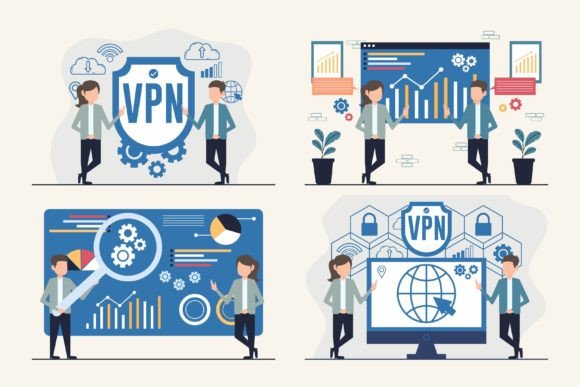
Business Analytics and VPN Illustrations: A Practical Guide to Vector Design Assets
In the rapidly evolving landscape of digital communication, visual assets play a critical role in conveying complex concepts quickly and effectively. Among the most versatile tools available to designers and content creators are vector illustrations focused on specific themes like Business Analytics and VPN Illustrations. These resources bridge the gap between technical functionality and visual storytelling, offering a scalable solution for modern web and mobile design needs. Unlike raster images that degrade when resized, these vector-based graphics maintain crisp edges and perfect clarity regardless of how they are manipulated.
The core value of this specific collection lies in its dual focus. Business analytics represents the data-driven decision-making processes essential for modern enterprises, while Virtual Private Network (VPN) imagery addresses the growing public concern regarding cybersecurity and privacy. Combining these themes into a cohesive set of editable vector files allows professionals to create narratives that connect data security with business intelligence. Whether you are designing a landing page for a SaaS product or an infographic explaining corporate firewalls, having high-quality, adaptable visuals is paramount.
Understanding the Distinctive Value of Editable Vector Assets
What sets Business Analytics and VPN Illustrations apart from standard stock photography or pre-rendered icons is the underlying technology: 100% vector construction. In graphic design, vectors are mathematical descriptions of shapes rather than grids of pixels. This fundamental difference means that every element within the design template can be transformed, scaled up or down, and recolored without any loss of quality. For a designer working across multiple platforms—from a small mobile banner to a massive hero image on a desktop site—this scalability is not just a convenience; it is a necessity.
The ability to edit these files directly in vector graphics software opens up a realm of customization that static images cannot match. You can remove unnecessary elements, add new text layers, or adjust color palettes to align perfectly with your brand identity. For instance, if your project requires a specific shade of blue to match your company logo, you can recolor the entire illustration instantly. This flexibility ensures that the final output feels bespoke rather than generic, which is crucial for maintaining brand consistency across various marketing channels.
Technical Specifications and File Formats
A comprehensive package of Business Analytics and VPN Illustrations typically includes source files in EPS (Encapsulated PostScript) format. EPS remains a gold standard in the industry because it is widely compatible with professional design software such as Adobe Illustrator, CorelDRAW, and Affinity Designer. This compatibility ensures that you have full access to the individual layers and paths that make up the illustration. Additionally, the inclusion of high-resolution JPG files provides immediate usability for contexts where vector editing is not required, allowing for quick integration into presentations or social media posts.
Having both the editable source files and the ready-to-use raster versions offers a strategic advantage. It streamlines the workflow by eliminating the need to export or convert formats repeatedly. When time is a constraint, the JPGs serve as a reliable fallback, while the EPS files remain available for deep customization later in the project lifecycle. This dual-format approach caters to both rapid prototyping and polished final production.
Comparing Vector Illustrations with Alternative Visual Resources
When evaluating options for visual content, it is essential to compare Business Analytics and VPN Illustrations against other common alternatives such as stock photography, 3D renders, and flat icon sets. Each option has its strengths, but vectors often strike the best balance between aesthetic appeal and functional utility for technical topics.
- Stock Photography: While photos offer realism, they can struggle to depict abstract concepts like "data flow" or "encrypted tunnels." Photos also suffer from resolution limits and often require heavy retouching to fit specific color schemes. Vectors solve these issues by providing stylized representations that are universally understood and infinitely scalable.
- 3D Renders: Three-dimensional graphics are visually stunning but often come with significant file size bloat and longer load times, which can negatively impact website performance. Furthermore, modifying a 3D render usually requires specialized skills and software. Vector illustrations are lightweight, load instantly, and can be edited with basic design knowledge.
- Flat Icon Sets: Icons are useful for UI elements but lack the narrative depth needed for hero sections or detailed infographics. The illustrations in this category provide more context and detail, allowing them to stand alone as primary visual anchors rather than just supplementary decorations.
The tradeoff with vector illustrations is that they may lack the photorealistic texture of a photograph. However, for topics involving technology and data, a clean, stylized look is often preferred over realism. It reduces cognitive load for the viewer, allowing them to focus on the message rather than getting distracted by photographic details.
Evaluating Strengths and Tradeoffs for Your Project
Deciding whether to invest in a set of Business Analytics and VPN Illustrations depends heavily on the scope and goals of your project. One of the primary strengths is versatility. A single asset pack containing 100 vector source files can support dozens of different campaigns. You might use one illustration for a blog post about data privacy, another for a webinar slide deck on market trends, and a third for a mobile app's loading screen. This reusability significantly lowers the cost per use compared to commissioning custom artwork for every single touchpoint.
However, there are limitations to consider. While the templates are highly editable, they still rely on the user's proficiency with vector software. If you lack experience with tools like Adobe Illustrator, you may find yourself limited to using the provided JPGs or hiring a freelancer to make adjustments. Additionally, while the style is generally modern and clean, it may not fit brands that require a highly specific, non-standard artistic direction. In such cases, a custom commission might be necessary, though at a much higher price point.
Another factor is the level of abstraction. These illustrations are designed to be broadly applicable. They represent general concepts of analytics and security rather than specific proprietary interfaces. If your goal is to show exactly what your unique dashboard looks like, these generic illustrations will need significant modification or supplementation with actual screenshots.
Best-Fit Situations for Vector Graphics
The ideal scenarios for utilizing Business Analytics and VPN Illustrations include:
- Landing Pages and Hero Images: Large, impactful visuals that need to scale across all device sizes without pixelation.
- Infographics: Complex data stories that require clear, scalable charts, graphs, and connecting lines.
- Mobile Web and Apps: Environments where file size matters, and crisp rendering on high-density screens is non-negotiable.
- Presentation Decks: Slides that will be projected on large screens or printed as handouts, requiring maximum clarity.
- Banners and Ads: Marketing materials that need to be resized frequently for different ad placements (e.g., Google Display Network).
In these contexts, the ability to transform and recolor elements without losing quality becomes a decisive factor. For example, if you are running A/B tests on a landing page, you can quickly generate variations of the hero image by changing colors or swapping out specific icons to see which version performs better.
Decision Factors: When to Choose Vectors vs. Alternatives
Choosing the right visual resource is ultimately about alignment with your project requirements. Business Analytics and VPN Illustrations are the right choice when you need speed, scalability, and adaptability. They are particularly effective for startups and agencies that need to produce high volumes of content with a consistent visual language. The ability to edit the files means you can iterate quickly based on feedback, making them ideal for agile development environments.
Conversely, you might need to look elsewhere if your project demands hyper-realism or if the subject matter is so niche that no generic illustration fits. For instance, if you are creating a medical device manual, a stylized vector might not convey the necessary precision. Similarly, if your brand identity relies heavily on photography and human emotion, a purely illustrative approach might feel disconnected.
It is also worth considering the long-term maintenance of your assets. Vector files are future-proof. As screen resolutions increase and display technologies evolve, vector graphics will continue to look sharp. Raster images, on the other hand, may eventually become obsolete or require expensive re-shooting or re-rendering. By investing in a robust library of vector sources, you are building a sustainable asset base that can grow with your organization.
Practical Application and Workflow Integration
Integrating Business Analytics and VPN Illustrations into your workflow is straightforward once you understand the file structure. Upon receiving the 100 vector source files, the first step is to organize them logically within your project management system. Since the files are in EPS format, you should open them in your preferred vector editor to inspect the layers. Most well-constructed packs will have organized layers for background, main subjects, and decorative elements, making it easy to isolate specific parts.
For a practical example, imagine you are designing a banner for a cybersecurity conference. You could select a base illustration featuring a shield and a network graph. Using the vector tools, you might change the shield's color to match the conference theme, remove a background element that clutters the composition, and add the event date as a text layer. Because the original quality is preserved, the final export for print will be flawless, and the same file can be resized for a social media thumbnail without any degradation.
This level of control empowers designers to move beyond simple placement and into true creation. It transforms a stock asset into a custom piece of art tailored specifically to the message you wish to convey. Whether you are explaining the intricacies of data encryption or visualizing quarterly growth metrics, these illustrations provide the structural foundation upon which compelling visual stories are built.
Ultimately, the decision to use Business Analytics and VPN Illustrations comes down to a desire for quality, flexibility, and efficiency. In a digital world where attention spans are short and visual competition is fierce, having access to high-fidelity, editable graphics can make the difference between a message that resonates and one that is overlooked. By understanding the capabilities and limitations of vector assets, you can make informed decisions that enhance your projects and deliver superior results for your audience.